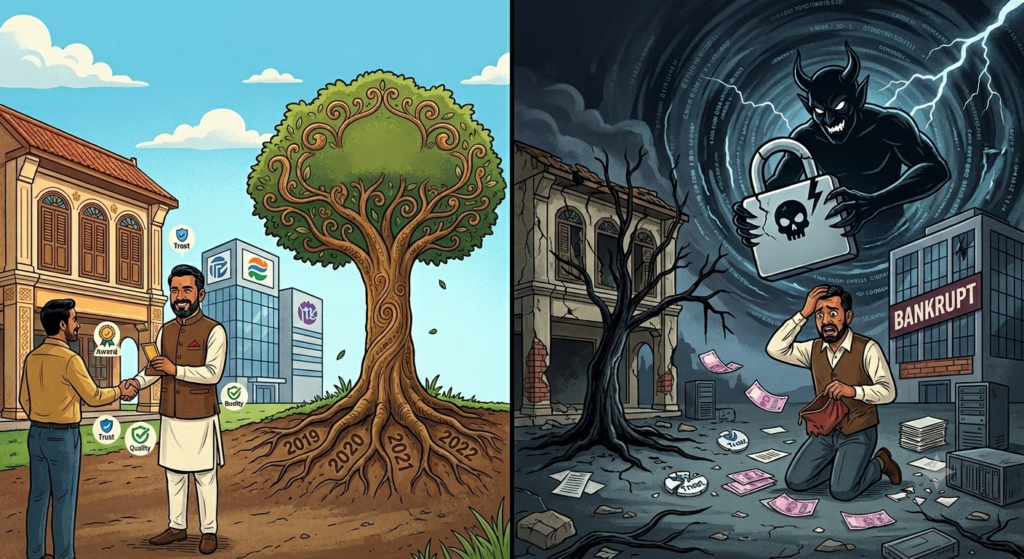
Imagine Equifax, an American company that people have long trusted with their financial information. Businesses relied on its credit service to make important lending decisions. Millions of people gave Equifax their personal information. By 2017, Equifax had become one of the largest companies that tracked people’s credit.
Then something devastating happened. Some hackers got into Equifax’s computer systems and gained unauthorized access to the personal information of almost 147 million people. After that, news stories around the country began asking whether Equifax was doing a good job of keeping people’s information safe. The price of Equifax stock fell sharply. And the company’s reputation was hurt badly. It took Equifax a long time to regain people’s trust. This whole thing was a reminder that when we are online, it’s not just how much money a company makes or the technology it uses or where it stands in the market. Instead, it’s the trust that its customers have in the company.
Hence, in today’s digital modern economy, a company’s most vital asset is its reputation. This is because, no matter what your business does, collecting data is probably a part of it. And much of that data will be sensitive customer information. This means that data collection processes must comply with privacy laws and regulations issued by government bodies, as well as one’s own company policies. This is because following data privacy rules is not just about meeting requirements; it also helps build and keep customer trust. When customers feel their data is secure with you, they will trust you to provide products and services. A strong focus on privacy and compliance also makes one’s brand look good and can help to enter new markets. It is good for one’s reputation and can open up new chances to grow their business.
Why Reputation Matters More Than Ever?
In today’s world, where customers can easily rate a company, online reputation really matters. A company’s good reputation can come from reviews, social media comments, press coverage, friends telling each other, or people recommending a brand to others. For medium-sized businesses that want to grow, being seen as reliable and trustworthy is crucial. They need to build a reputation to succeed. In fact, in cases of large-sized businesses, data leaks can affect their weeks, months, and even years of hard-earned reputation. This means reputation is everything for small and medium-sized enterprises.
A data breach does more than just leak information. It destroys customer relationships, investor confidence, business partnerships, stakeholder trust, and the overall credibility of the organization by undermining the trust on which these relationships are built. Customers may feel let down. They might think that the company does not care about their data. Investors may ask if the company is run well. Business partners may not trust the company to keep information safe. Financial losses can usually be fixed, but damage to a company’s reputation can last for years. The breach makes customers, investors, and partners question the company’s data breach. It makes them lose trust in the company. Thus, in an era where news spreads fast on social media and the internet. If something small goes wrong with security, it can turn into a problem for a company’s reputation. News stories, people complaining, and lots of discussions online can hurt how people see a brand in just a few hours. A security incident can become a problem for a brand’s image because news travels so fast on social media and digital platforms.
Lessons for Indian Businesses
Indian businesses are getting more into using computers and the internet. They are also collecting a lot of personal information about people. However, this also increases the risk of misuse and unauthorized access to such information. Therefore, businesses must be careful while handling and protecting the personal data of individuals.
The first lesson is to keep only the information that one really needs, and make sure that the right people have access to this information. When it is limited who can see the data, the chances of the data being exposed are reduced. This also helps to reduce the damage that can happen if there is a breach of the data. Limiting access to the data is a way to protect the data and keep it safe.
The second lesson is not to overlook third-party partners, as many organizations forget that suppliers and service providers can be a link. These third-party partners can be used by cyber criminals to access your data if they’re not secure. Therefore, one needs to make sure they follow the security standards, as it is important to check that they maintain those standards.
The third lesson is not to overlook the risk of outdated systems, as many companies usually spend a lot of money on new systems. But, do not take good care of the systems they already have. A lot of them are still using systems that are not updated regularly. These old systems do not get the security fixes they need and thus can expose data to cyber criminals.
The fourth and last lesson is not to focus too much on technology and not enough on people. This is because having the latest technology is important for any organization, but sometimes we forget that the people who work for us and the way they do things are just as important as the technology we use. The employees at our organization need to learn about security practices so they can do their jobs safely. Everyone should follow the steps to keep the people’s data in the organisation safe. If the organisation trains employees regularly and talks to them often, then they can make sure that everyone at the organisation thinks about the security of data. Security is something that everyone who works for our organization should think about every day.
Importance of DPDP Act Compliance
The digital economy has grown fast, and now personal data is super valuable to businesses. When companies use platforms to collect, store, and process personal information of people start to worry about their privacy, data security, and how their data might be misused. These worries have increased as more organizations depend on such platforms, so to address these concerns, India has made a law called the Digital Personal Data Protection Act, 2023. The main goal of the DPDP Act is to protect people’s privacy rights in the world. Personal data protection is a part of this, and the DPDP Act aims to keep people’s personal data safe. The digital economy and personal data are closely linked. The DPDP Act tries to balance the needs of businesses with the need to protect people’s personal data. The DPDP Act 2023 is a step towards keeping personal data safe and protecting people’s privacy. Following the notification of the DPDP Rules, 2025, the main parts of the Act will become fully enforceable from May 2027.
The Digital Personal Data Protection bill is a set of rules that will help keep the information of Indian citizens safe. This law is for any company that’s in India or in another country and uses the personal information of Indian citizens to sell them things or provide services. The Digital Personal Data Protection bill will say how these companies can collect, use, and share the information of their customers. It will give people power over their own information and will also make sure that companies follow rules to protect the personal information of Indian citizens.
Thus, compliance with the Digital Personal Data Protection Act 2023 is not about following the law or avoiding fines; it’s a chance for organizations to improve how they handle data, show that they are responsible, and build trust with stakeholders. By having security in place and being careful with personal data, businesses can lower the risk of data leaks and protect their reputation, which helps them in the marketplace.
— by Riya Dawra