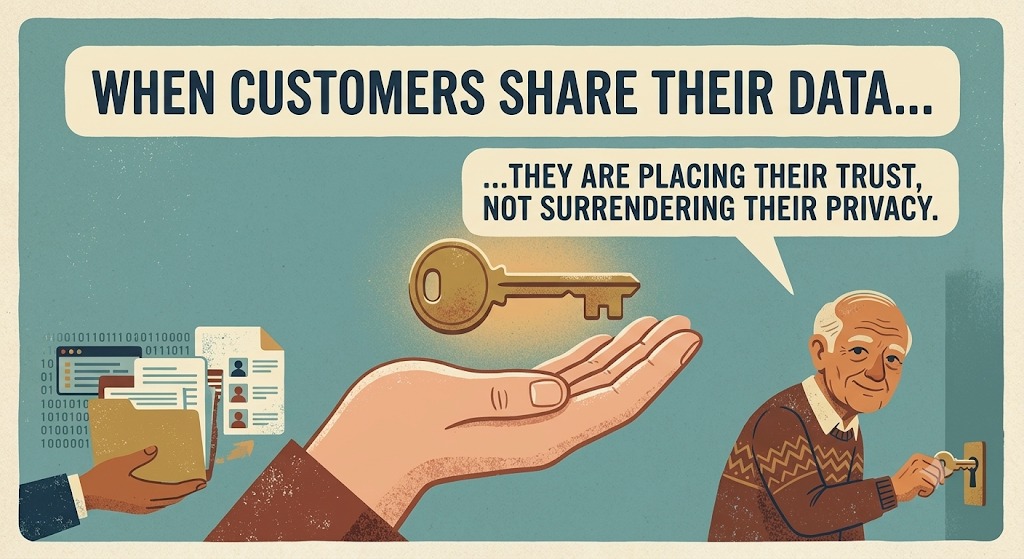
Imagine handing your house keys to a neighbour while you’re away. You do not do so because you have something to hide, but because you trust them to protect what belongs to you. Personal data works the same way. When customers share their information with a company, they are placing their trust and not surrendering their privacy. Yet many organizations still dismiss concerns with a familiar refrain: “We have nothing to hide.” However, privacy has never been about secrecy; it has always been about responsibility.
That idea, “if you’re not doing anything wrong, you don’t need privacy,” comes from a common but misleading view of privacy law. It treats privacy like a shield only for people with secrets. But privacy isn’t about guilt or innocence.
People today hand over a lot of personal information, such as their names, addresses, payment card details, the sites they visit, medical notes, and even fingerprints, because they trust organizations to treat that information with care, not because they’ve given up their right to privacy.
So the question privacy law asks isn’t “Does the company have something to hide?” It asks, “Has the company respected the people behind the data?” That means keeping information safe, using it only in ways people would expect, being honest about what’s happening with it, and giving people control where possible. When companies meet those obligations, they honor the basic trust people place in them.
Why privacy matters so much
- The digital economy runs on data
Businesses in contemporary times collect streams of information from each and every website that we visit, every online purchase, customer question, etc., and that data creates a better customer experience with smarter personalization, and more efficient operations while driving overall growth. However, the more data an organization collects, the greater its responsibility to protect it.
2. customers Expect Privacy
Today’s consumers understand how their data is used and demand clear transparency, strong accountability, and meaningful control over personal information. A single privacy lapse can erase years of trust almost instantly, and when customers lose confidence in a company’s data practices, they frequently take their business to competitors.
Privacy is not just good business, but it is now a legal obligation
Privacy is no longer just about keeping things secret, but it is also about being responsible, and that idea is now reflected in law as well. In India, the Digital Personal Data Protection Act, 2023, marks an important shift in how organizations handle personal data. It moves the focus away from whether a company has something to hide and toward whether it is treating people’s data with care and responsibility. The law makes it clear that personal data belongs to individuals, while organizations that collect and use it are only custodians of that information. Under this Act, Data Fiduciaries must process data for lawful purposes, take valid consent where needed, stay transparent about how data is used, and put proper security measures in place. In simple terms, the law puts into practice what people have always expected: respect, accountability, and trust.
Importantly, the DPDP Act strengthens the idea that privacy is about control, not secrecy. People should be able to understand how their data is being used and trust that organizations will handle it with care. In that sense, compliance is not just about avoiding fines; it is about preserving the confidence customers place in a business.
The Real Cost of the “Nothing to Hide” Mindset
The problem with saying “we have nothing to hide” is that it can make organizations underestimate how important privacy really is. When privacy is treated as an afterthought instead of a core responsibility, businesses may become careless about how they collect, store, and protect personal information.
That carelessness can be costly. A data breach, unauthorized sharing, or misuse of personal data can lead to more than just regulatory trouble. It can hurt a company’s reputation, weaken customer trust, and damage relationships with business partners. In many cases, the loss of confidence lasts much longer than any fine.
Customers may sometimes overlook minor service issues, but they are much less forgiving when their personal information is mishandled. Once trust is broken, rebuilding it can take years.
Privacy as an Advantage
Businesses that take privacy seriously are often seen as more trustworthy and responsible. They are clear about how they use data, collect only what they need, and put strong protections in place to keep information safe.
This does more than reduce risk—it adds value. More and more customers prefer to deal with companies that show respect for their privacy. In a competitive market, strong privacy practices can become a real advantage rather than just a legal requirement.
Conclusion
In the end, privacy should be seen as a fundamental part of how a business earns and keeps trust, not as a legal checkbox or a technical inconvenience. The idea that there is “nothing to hide” misses the larger point: people care not only about whether their information is hidden, but about whether it is handled with care, honesty, and respect. As businesses continue to depend more heavily on data, their success will increasingly depend on how responsibly they manage it. Companies that show they value privacy are more likely to build lasting relationships, strengthen their reputation, and stand out in a market where trust matters more than ever. In this way, privacy becomes more than a compliance issue, which becomes a reflection of a company’s values and its commitment to the people it serves.
— Arsha Dutta