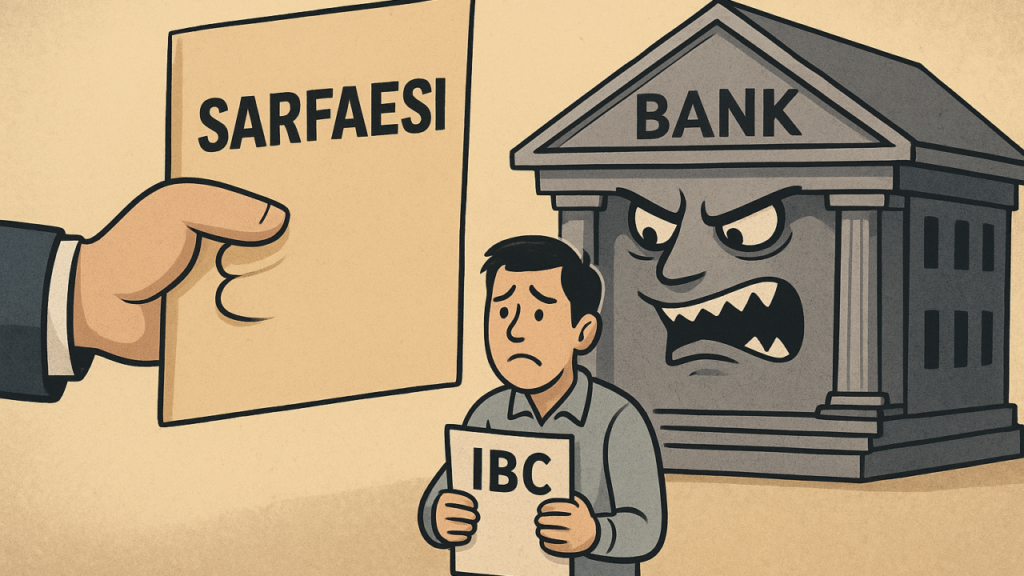
If you are reading this with a heavy heart, wondering how a short-term crisis turned into endless notices, phone calls, and even the fear of losing your home or business, then know that you are not alone. Across India, countless families and entrepreneurs who once borrowed in good faith are being crushed under the weight of recovery actions taken by banks under the SARFAESI Act and the Insolvency and Bankruptcy Code (IBC).
While these laws were created with the intention of speeding up the recovery of genuine dues and ensuring financial discipline, in practice they are often misused in a way that forgets the human being behind the loan account. The result is not just financial loss, but emotional distress, sleepless nights, and a constant fear that life will never return to normal.
The SARFAESI Act was meant to empower banks to recover non-performing assets by allowing them, after giving a 60 day notice, to take over secured assets without first going through the courts. The IBC was designed as a time-bound framework to resolve the insolvency of companies and ensure that businesses in distress could either be revived or closed in an orderly manner. On paper, these mechanisms appear balanced and efficient. But the immense power they give to creditors has often been misapplied.
Banks, in their rush to clean up balance sheets or meet recovery targets, sometimes classify accounts as non-performing too quickly, ignore genuine requests for restructuring, or proceed with possession and auction without giving the borrower a fair chance to regularise the account. There are even instances where notices are issued mechanically, valuations are done at distress levels, and auctions are conducted without transparency, leaving borrowers feeling stripped of their dignity and livelihood.
For borrowers, the impact goes beyond paperwork. Behind every so called “default” lies a story: a business owner who lost orders because of a policy change, a shopkeeper whose supply chain collapsed due to lockdowns, a family drained by medical emergencies, or a farmer at the mercy of floods or drought. These are not acts of negligence; they are realities no one can control.
Yet when banks treat such borrowers as wilful defaulters and push them into enforcement without listening to their circumstances, the stress inflicted is immense. Families face social embarrassment, children sense the tension at home, and the borrower themselves is left in a cycle of guilt and despair. Many who approach us are not people who wanted to walk away from their obligations they simply needed time and understanding to get back on their feet.
This becomes most apparent in situations of force majeure, where external shocks make repayment genuinely impossible. We saw this during the COVID-19 pandemic, when businesses across industries came to a standstill and incomes dried up overnight. The Reserve Bank of India itself recognised the crisis and allowed moratoria on instalments, later introducing special resolution frameworks to restructure loans.
Despite this, several banks pressed ahead with recovery actions as if nothing had changed, issuing notices and demanding repayments that borrowers simply could not make. Such behaviour ignores the very spirit of the law, which recognises that unforeseen events can make temporary non-payment inevitable, and that solutions like restructuring or temporary relief should be explored before resorting to drastic enforcement.
What the law requires is not blind enforcement, but due process. When a bank issues a notice under SARFAESI, it is obliged to give the borrower sixty days to respond, state the exact dues, and consider any representation made by the borrower. Only if the bank rejects the borrower’s proposal with reasons can it proceed to take possession or auction the asset. Even then, valuations must be fair, auctions must be transparent, and reserve prices cannot be fixed arbitrarily low. Yet time and again, borrowers are not given meaningful hearings, objections are brushed aside with one-line rejections, and assets are hurriedly sold at prices far below their worth. Courts have repeatedly warned against these practices, reminding banks that borrowers’ rights are an integral part of the recovery process.
The IBC too is sometimes misused as a weapon rather than a remedy. Creditors often initiate insolvency proceedings the moment a default occurs, treating it as an automatic admission that the company is insolvent. But the law does not equate a short-term cash-flow problem with insolvency. Many businesses are viable in the long run but face temporary liquidity issues caused by delayed payments from clients, sudden market disruptions, or regulatory changes.
The Supreme Court has clarified that tribunals are not meant to be rubber stamps for creditors; they must consider whether there is a genuine dispute or whether the business can be revived. Sadly, many small and medium enterprises are still pushed into insolvency proceedings prematurely, not because they are fundamentally unviable, but because the bank sees the IBC as an easy hammer to extract repayment.
The plight of small borrowers and MSMEs is particularly heartbreaking. These businesses form the backbone of the Indian economy, providing jobs and supporting local communities, yet they are the most vulnerable to external shocks. Recognising this, the government and RBI have issued frameworks to provide special relief for MSMEs in distress, including simplified restructuring mechanisms.
Still, many banks fail to apply these measures and instead choose the harshest route available, leaving business owners devastated. In some cases, a factory built with decades of hard work is auctioned off in weeks, destroying not only the business but also the livelihoods of employees and families connected to it.
What is important for borrowers to know is that they are not powerless. The law provides remedies. Under SARFAESI, borrowers can approach the Debts Recovery Tribunal to challenge wrongful actions, point out procedural defects, and seek relief from possession or auction. Under the IBC, admission of a case can be resisted if the company is fundamentally solvent or if there is a genuine dispute about the debt.
Courts have also intervened when banks act mechanically, when notices are flawed, or when valuations are questionable. Beyond the courts, there are frameworks for restructuring, particularly for MSMEs, which borrowers can invoke to seek fair resolution instead of liquidation.
– By Aniket Anand